Cardiac — Parasternal Long Axis (PLAX)
The foundational cardiac window: left ventricle, left atrium, mitral and aortic valves, and pericardium in one view.
Learning objectives
- Obtain an interpretable PLAX view, including patient positioning and probe adjustments.
- Identify the LV, LA, LVOT, aortic and mitral valves, and pericardium.
- Distinguish a pericardial effusion from a pleural effusion using the descending aorta.
- Make a qualitative assessment of LV systolic function (including EPSS).
Maps to
- Resident: ACEP Emergency Ultrasound — Cardiac: Image Acquisition (PLAX)
- Resident: ACEP Emergency Ultrasound — Cardiac: Image Interpretation (LV function, effusion)
- Tech: ARDMS Adult Echocardiography (AE) — standard parasternal long-axis view
Acquisition — getting the view
- Probe
- phased-array
- Patient position
- Supine, or left lateral decubitus to bring the heart against the chest wall and improve the window.
- Orientation convention
- cardiology
- Probe placement
- Left sternal border, 3rd–4th intercostal space
- Marker direction
- Toward the patient's right shoulder (~10–11 o'clock). Note: cardiology convention places the screen indicator on the RIGHT.
Probe placement (3D)
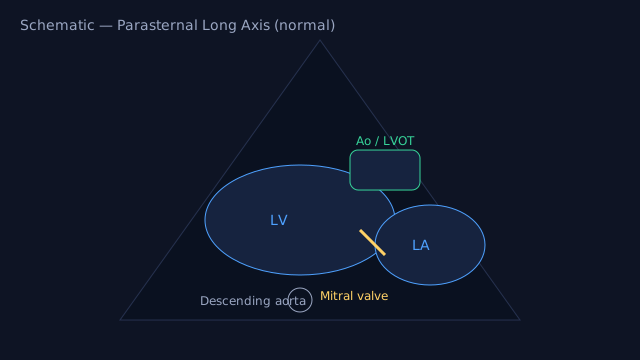
Structures in the imaging plane (near → far): Chest wall · Right ventricular outflow · Interventricular septum · Left ventricle · Mitral valve · Left atrium · Aortic valve / LVOT · Pericardium · Descending thoracic aorta
Step by step
- Place the phased-array probe just left of the sternum at the 3rd–4th intercostal space, marker toward the right shoulder.Why: Aligns the scan plane with the long axis of the LV from base to apex.
- Rock and slide one rib space up or down until the LV, mitral valve, and aortic valve all appear in a single plane.Why: Rib shadows and off-axis planes foreshorten the ventricle.
- If the image is poor, roll the patient into left lateral decubitus and scan during held expiration.Why: Brings the heart closer to the chest wall and removes lung between probe and heart.
Troubleshooting
- Rib shadows obscure the heart.
- Slide up or down one intercostal space and angle the beam between the ribs.
- The ventricle looks short/foreshortened.
- You are off-axis — rotate slightly and aim the plane through the true long axis (apex to base).
- Poor penetration / dark image.
- Confirm the cardiac preset, increase depth/gain, and reposition to left lateral decubitus.
Findings: normal
Normal PLAX anatomy
LV and LA of comparable size, thin mobile mitral and aortic valve leaflets, LVOT continuity, and no fluid in the pericardial space.
Signs: Anterior mitral leaflet nearly touches the septum in diastole (low EPSS)
Findings: pathology
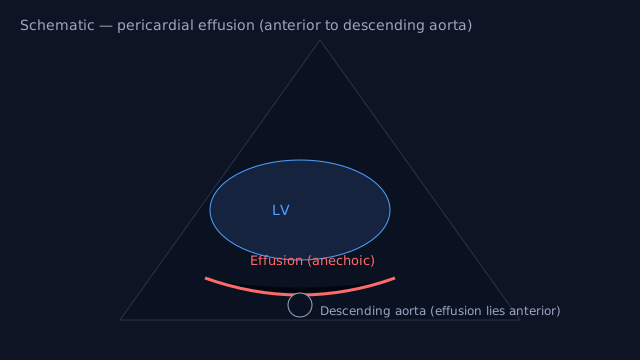
Pericardial effusion
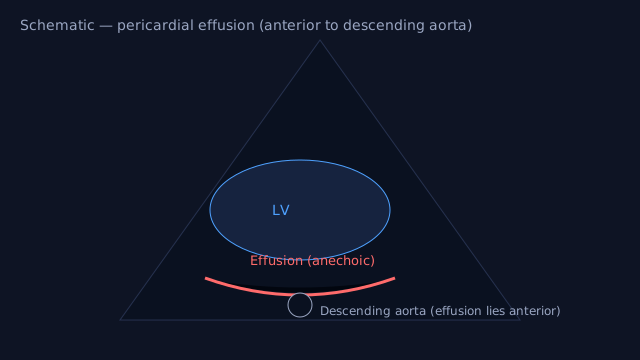
Anechoic stripe within the pericardial space. It tracks ANTERIOR to the descending thoracic aorta, which distinguishes it from a pleural effusion (posterior to the aorta).
Signs: Effusion anterior to descending aorta = pericardial; Diastolic RV collapse suggests tamponade physiology
Reduced LV systolic function
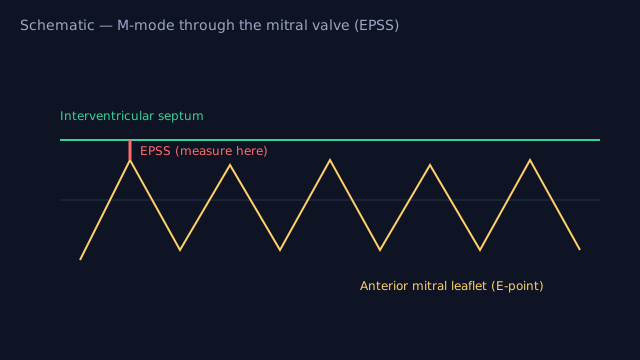
Poor wall thickening/excursion and an enlarged EPSS (E-point septal separation) indicate reduced ejection fraction.
Signs: Increased EPSS (anterior mitral leaflet far from septum)
Interpretation practice
An anechoic stripe is seen running ANTERIOR to the descending thoracic aorta on this PLAX view. What is it?
Measurement practice
Measure the E-point septal separation (EPSS): the gap between the anterior mitral leaflet at its peak opening and the interventricular septum.
Check your understanding
Which structure is used on the PLAX view to distinguish a pericardial from a pleural effusion?
Which probe and convention are standard for PLAX?